The 8 Limbs of Yoga
When you mention the word “Yoga” to most people, they immediately think about people stretching and bending or breathing in certain ways. And whilst that is part of yoga, the limb known as Asana, and how many people are introduced to the practice, it is just one part of a much bigger picture.
Yoga is much more than postures, bending and breathing. It is more than what happens on the mat and, for me, I actually consider it a way of life. It is a way of living that invites steadiness, kindness, self-awareness and connection to ourselves and others, all of which I have found to be immeasurably helpful in my recovery.
My introduction to yoga didn't come through the physical practice of Asana. I was injured and actively trying not to exercise when yoga first came into my life. Instead, it was through mindfulness and meditation, and then reading more about yoga philosophy and the chakra system, that I became curious about how yoga might support me in my recovery.
Needless to say, that curiosity has led me to where I am today and I believe has helped direct my recovery journey. Yes, the physical practice is now part of my daily routine, even if some days that simply means lying on my mat for ten minutes! but it is just one of the eight limbs of yoga that I try to incorporate into my recovered life.
A Journey Beyond the Physical
The eight limbs of yoga offer a gentle framework for exploring a life that feels calmer, steadier and more connected, with kindness and self-compassion woven throughout.
They aren't a strict ladder that must be climbed perfectly; something that feels particularly important for us perfectionists trying to recover! Instead, they can be understood as eight interconnected aspects of yoga, each offering a different way of exploring ourselves, our relationships, our bodies, our breath, our attention and our sense of connection.
As we'll explore throughout this page, the eight limbs aren't necessarily eight separate practices. They can be understood as parts of a much bigger journey, one that gradually invites us to become more aware, more present and more connected, both with ourselves and with others.
And perhaps most importantly, yoga isn't about performing wellness. It isn't about becoming a perfect version of ourselves or ticking off everything we're supposed to be doing. It is about exploring what it means to live with greater awareness, compassion and authenticity.
I've shared my own perspective throughout this page, particularly where these ideas have intersected with my own recovery. You may connect with some of it, and other parts may not resonate with you at all. That's okay. There is no one right way to experience yoga.
If you'd like to explore these ideas a little more deeply, I've also created a downloadable companion to accompany this page. It brings the eight limbs together in one place and offers space to pause, reflect and consider what they might mean for you. You'll find it available to download at the bottom of this page.
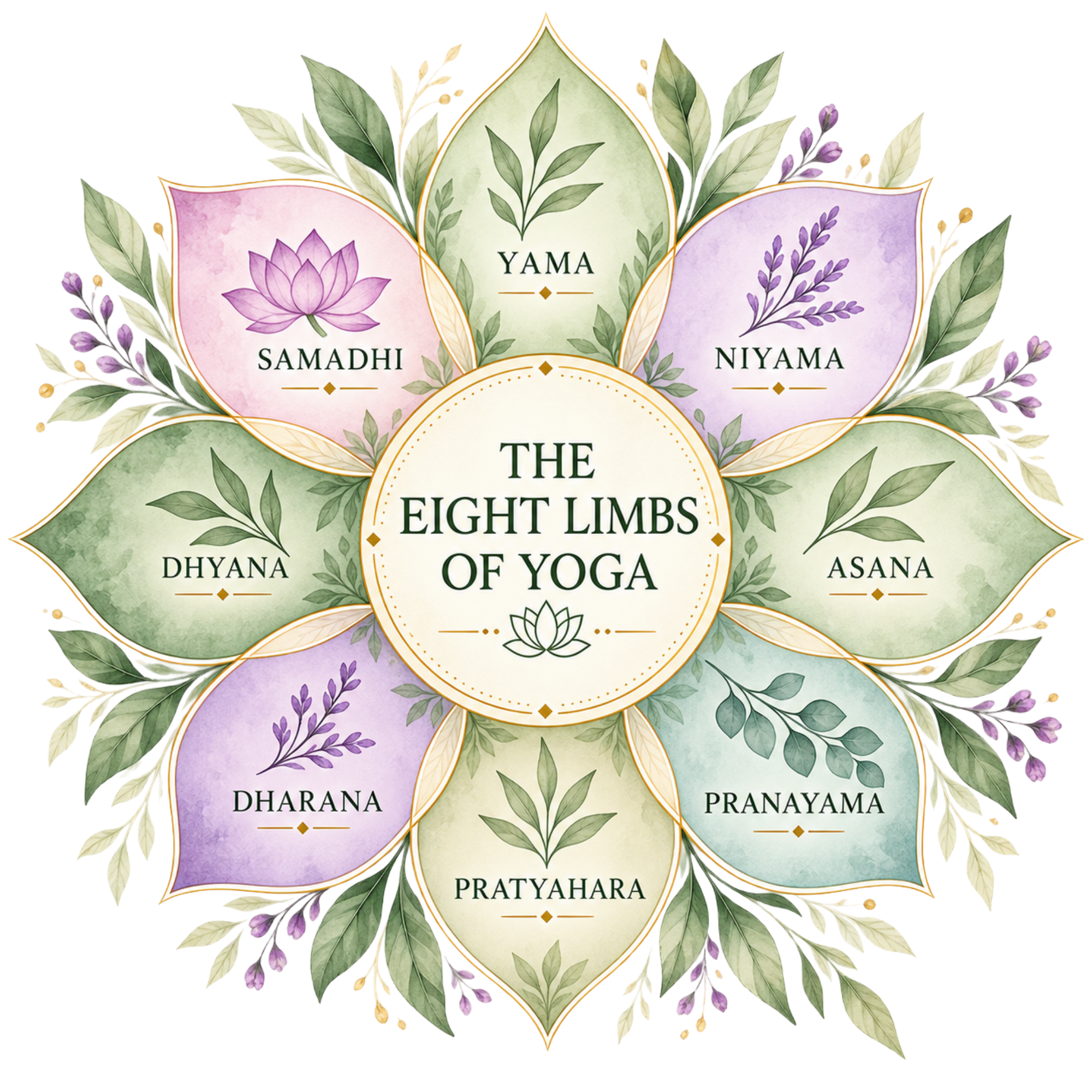
What Are The 8 Limbs of Yoga?
The Yamas
The Yamas the first of the eight limbs of yoga and explore how we relate to other people, the world around us, and the choices we make in our daily lives. Traditionally, the yamas are described as five ethical principles:
🪷 Ahimsa (non-harming)
🪷 Satya (truthfulness)
🪷 Asteya (non-stealing)
🪷 Brahmacharya (moderation or wise use of energy)
🪷 Aparigraha (non-grasping)
Rather than being a set of rules to be followed rigidity, the yamas can be understood as invitations to become more conscious of how we live and relate. They might encourage us to speak with kindness, be honest without being unkind, respect other people's boundaries and resources, notice where our energy is going, and gently explore where fear or attachment may cause us to hold on too tightly.
A recovery-informed perspective
In recovery, this way of thinking can offer another perspective: we can begin to consider how we relate not only to other people, but also to ourselves.
What would it mean to practise ahimsa (non-harming) towards ourselves?
What might truthful self-reflection look like without judgement?
Where might we be asking too much of ourselves, or holding tightly to rules that no longer serve us?
The Yamas are not about becoming a morally perfect person. It is about noticing, reflecting and making choices that move us towards greater kindness, honesty, respect and compassion, for ourselves and for the world around us.

The Niyamas
The Niyamas are the second of the eight limbs of yoga and turns our attention inward. If the Yamas explore how we relate to other people and the world around us, The Niyamas explore how we relate to ourselves; our inner life, our habits, our practices and our relationship with what we cannot control.
The five Niyamas are:
🪷 Saucha (purity or cleanliness)
🪷 Santosha (contentment or acceptance)
🪷 Tapas (discipline or committed practice)
🪷 Svadhyaya (self-study)
🪷 Ishvara Pranidhana (devotion or surrender).
These can sound quite formal at first, but they don't have to be understood as a list of things we need to perfect. Instead, they simply offer different ways of noticing how we live and what supports our wellbeing.
Saucha invites us to consider purity or cleanliness, both externally and internally. In a modern context, this might include creating an environment that supports us or becoming more aware of what we are taking into our minds and lives. It doesn't need to become another standard of perfection.
Santosha is often translated as contentment. This doesn't mean pretending everything is okay or giving up on growth. It can be an invitation to notice what is here, while allowing ourselves to meet the present moment without constantly needing it to be different.
Tapas is traditionally associated with discipline, effort or the willingness to stay committed to practice. Rather than punishment or forcing ourselves through discomfort, we might understand it as the steady energy we bring to something that matters to us.
Svadhyaya means self-study. It invites us to become curious about our thoughts, patterns, habits and responses. Through reflection, we can begin to understand ourselves more clearly — not so that we can criticise ourselves, but so that we can know ourselves more honestly.
Ishvara Pranidhana is traditionally connected with devotion or surrender. For some people this may have a deeply spiritual or religious meaning. For others, the idea of surrender may offer a way of recognising that we cannot control everything, and that sometimes practice involves softening our grip and allowing life to unfold.
A recovery-informed perspective
The Niyamas can offer a particularly gentle invitation during recovery: to explore what it means to care for ourselves without turning self-care into another set of rules.
Contentment doesn't mean we have to love everything about ourselves. Discipline doesn't mean pushing ourselves beyond our limits. Self-study doesn't mean endlessly analysing what is wrong with us. And surrender doesn't mean giving up.
Instead, these practices can invite curiosity, compassion and flexibility. We can begin to ask:
What supports me?
What am I learning about myself?
Where might I be pushing too hard?
What could I allow to be enough for today? And what might happen if I loosened my need to control every outcome?
The Niyamas are not another checklist for becoming a better version of ourselves. They are an invitation to develop a kinder, more conscious relationship with the person we already are.
Asana
Asana is the third of the eight limbs of yoga and is the limb most familiar to most people today. It refers to the physical postures and positions practised in yoga. But traditionally, asana is not simply about how a pose looks, how flexible we are, or how difficult a posture can be.
The Sanskrit word asana is often translated as “seat” or “posture”. In the broader practice of yoga, physical postures can provide an opportunity to explore steadiness, awareness and our relationship with the body. Rather than being something we need to perform perfectly, a posture can become a place to notice what is happening — physically, mentally and emotionally — in the present moment.
This means that yoga doesn't have to be about achieving the deepest version of a pose, touching our toes, standing on our heads or progressing towards increasingly difficult postures. The practice can be much quieter than that.
A gentle movement, a supported posture, sitting comfortably, or simply noticing how the body feels can all become opportunities to practise awareness.
What might this look like in everyday life?
Asana can invite us to become curious about our bodies rather than constantly evaluating them.
We might notice:
🪷 How a particular movement feels rather than how it looks.
🪷 Where we are holding tension.
🪷 When our body is asking us to pause.
🪷 What feels supportive or comfortable today.
🪷 When we need to adapt, rest or stop.
🪷 How our experience of a posture changes from one day to another.
There is no requirement for the body to look a certain way, move in a particular way or achieve a particular shape for the practice to have value.
A recovery-informed perspective
For someone recovering from an eating disorder or struggling with body image, the physical practice of yoga can bring up complicated feelings.
It can be tempting to approach movement as something we need to be good at, something that should burn calories, change our bodies or prove what they are capable of. Recovery can invite us to explore a different relationship with movement.
What if the purpose of a yoga posture wasn't to change your body, but to experience your body?
What if we didn't need to push further simply because we could?
What if resting was part of the practice rather than something we had failed to earn?
And what if we allowed ourselves to choose a variation that felt supportive rather than automatically choosing the most challenging one?
Asana doesn't ask us to make our bodies worthy of care. Our bodies are already worthy of care.
Perhaps the practice, then, becomes less about perfecting the pose and more about coming into relationship with ourselves exactly as we are today.
Pranayama
Pranayama is the fourth of the eight limbs of yoga and brings our attention to the breath. While breath is naturally part of every yoga practice, pranayama involves intentionally working with the breath through different practices and techniques.
For many people, simply becoming aware of the breath can be a powerful practice. We might notice its rhythm, pace, depth or how it changes in response to what we are experiencing. Other pranayama practices may deliberately alter the breath through techniques such as lengthening the exhalation, alternate nostril breathing or humming.
The purpose isn't necessarily to make the breath behave in a particular way. It can also be about developing a more conscious relationship with something that is already happening, moment by moment.
Practising Pranayama doesn't always need to be a formal breathing practice…
🪷 It might begin with simply noticing:
🪷 What your breath is doing right now.
🪷 Whether you're breathing quickly or slowly.
🪷 Where you notice the movement of the breath in your body.
🪷 Whether your breath changes when you're stressed, excited or at ease.
🪷 What happens when you allow the breath to be just as it is.
If a particular breathing practice feels comfortable, we might then explore it with curiosity rather than trying to achieve a particular result.
And sometimes choosing not to change the breath at all can be the practice.
A recovery and trauma-informed perspective
Breath practices aren't necessarily comfortable for everyone.
For some people, paying close attention to the breath can increase anxiety, create a sense of being trapped or bring awareness to physical sensations that feel difficult or unfamiliar. Breath retention or deliberately changing the pace or depth of breathing can also feel uncomfortable.
There is therefore no requirement to practise a particular breathing technique simply because it is described as calming or beneficial.
You might choose to keep your eyes open. You might focus your attention somewhere else. You might breathe naturally rather than following a prescribed rhythm. You might stop altogether.
You are allowed to change the practice to meet your needs.
Rather than asking “Am I doing this breathing exercise correctly?”, perhaps we can ask:
“Does this feel supportive for me right now?”
And if the answer is no, listening to that response is not a failure of the practice.
Sometimes the most mindful thing we can do is allow the breath to breathe itself.
Pratyahara
Pratyahara is the fifth of the eight limbs of yoga and invites us to explore our relationship with our senses. Often translated as “withdrawal of the senses”, the idea can sound quite strange at first. It doesn't mean shutting ourselves away from the world or trying to stop ourselves from seeing, hearing or feeling.
Instead, pratyahara can be understood as learning to turn our attention inward and become less automatically pulled by everything happening around us.
Our senses are constantly receiving information. We hear sounds, notice movement, experience physical sensations, see things around us and respond to what is happening. Much of this happens without us consciously choosing or noticing where our attention goes.
Pratyahara offers an opportunity to pause and notice this process. Rather than automatically following every sound, thought, sensation or distraction, we can begin to notice what has captured our attention and then choose whether we want to stay with it.
Pratyahara doesn't have to mean sitting in silence with your eyes closed.
It might look like:
🪷 Taking a few moments away from your phone and other sources of stimulation.
🪷 Sitting quietly and noticing the sounds around you without needing to follow each one.
🪷 Closing your eyes (if that feels comfortable) or simply softening your gaze.
🪷 Noticing a physical sensation without immediately reacting to it.
🪷 Taking a break from the constant stream of information coming towards us.
🪷 Creating a few moments of quiet before moving on to the next thing.
It can also be as simple as noticing:
“My attention has been pulled towards that. Do I want to follow it?”
There is no need to force the senses to become quiet. The world can continue around us while we practise becoming a little less reactive to everything that asks for our attention.
A recovery and trauma-informed perspective
For someone in recovery, the idea of turning inward can be both helpful and complicated.
Our internal world doesn't always feel like a safe or comfortable place. Thoughts, emotions, memories and physical sensations can sometimes feel overwhelming. For someone with a history of an eating disorder, becoming more aware of the body can also bring up difficult feelings.
So pratyahara doesn't have to mean “close your eyes and go inside.”
You are allowed to choose where your attention feels safest.
That might mean looking around the room and noticing the colours and shapes around you. It might mean listening to a familiar sound. It might mean keeping your eyes open. It might mean grounding yourself in the room rather than turning inward.
The practice isn't about escaping from what we experience or forcing ourselves to sit with something that feels too much.
Instead, we can begin to explore a little more choice around our attention:
What am I noticing?
What am I being drawn towards?
Do I want to stay with this, or would something else feel more supportive right now?
Pratyahara reminds us that we don't have to follow every thought, sensation or stimulus that asks for our attention.
Sometimes creating a little space between noticing and reacting can be enough.
Dharana
Where Pratyahara is about becoming less automatically pulled by everything around us, Dharana is about choosing where we place our attention. It is the sixth of the eight limbs of yoga and explores the practice of focused attention. Having begun to notice where our attention is drawn through pratyahara, dharana invites us to consciously choose something to focus on.
That focus might be the breath, a sound, a visual object, a mantra, a sensation or even a particular idea. The object of focus itself is less important than the practice of gently gathering our attention and bringing it back when it wanders.
Our minds naturally move. Thoughts appear, sounds interrupt us, sensations change and our attention gets distracted. Dharana doesn't ask us to stop this happening. Instead, it gives us an opportunity to notice when we've drifted and practise returning.
The returning is part of the practice.
Dharana can be practised in many simple ways. We might:
🪷 Spend a few moments focusing on the sensation of our feet on the ground.
🪷 Listen closely to one sound.
🪷 Focus on the movement of the breath without trying to change it.
🪷 Repeat a word or phrase that feels meaningful.
🪷 Spend a few minutes drawing, colouring or doing something creative with our full attention.
🪷 Notice when our mind has wandered while reading, walking or completing a task and gently return to what we're doing.
There is no need for the mind to become completely still.
You might notice your attention wandering lots of times. Each time you notice and choose to return, you are practising.
A recovery-informed perspective
Dharana can be particularly helpful in reminding us that attention is something we can explore rather than something we need to control perfectly.
For someone in recovery, the mind can sometimes become intensely focused on food, body image, rules, routines or anxious thoughts. Trying to force those thoughts away isn't always helpful and can sometimes make them feel even louder.
Instead, we can begin to explore the possibility of choosing where we place our attention.
That doesn't mean ignoring difficult thoughts or pretending they aren't there.
It might simply mean noticing “My mind has gone there again. ”And then asking “Is there somewhere else I would like to place my attention right now?”
Sometimes that might be the breath. Sometimes it might be the feeling of your feet on the floor, the sound of someone speaking, the view from a window or the task in front of you.
You don't have to get rid of a thought in order to choose not to follow it.
And perhaps most importantly, there is no such thing as failing at concentration because your mind wandered.
The practice is not about holding your attention perfectly.
It is about learning that you can notice, choose and return.
Dhyana
Dhyana is the seventh of the eight limbs of yoga and is often translated as meditation or meditative absorption. It follows naturally from dharana, the practice of focused attention.
With dharana, we consciously choose an object of attention and practise returning to it when the mind wanders. In dhyana, that attention begins to become more continuous and less interrupted.
Rather than repeatedly noticing “My mind has wandered” and returning, there can be moments when the distinction between the person observing and the thing being observed begins to soften. The practice becomes less about actively directing attention and more about allowing awareness to remain with what is present.
This isn't something we need to force. It isn't about emptying the mind or achieving a particular state. Thoughts can still arise. Sounds can still be heard. Sensations can still be noticed. The difference is that we may become less caught up in following each one.
Like I said, dhyana is often associated with meditation, but it doesn't have to mean sitting perfectly still for a long period of time. It might involve:
🪷 Sitting quietly and allowing awareness to rest with the breath.
🪷 Listening to a sound without needing to analyse it.
🪷 Spending time in nature and becoming absorbed in what you see, hear and experience.
🪷 Allowing yourself to become fully immersed in a creative activity.
🪷 Walking with a sense of presence rather than rushing towards the next thing.
🪷 Experiencing moments when you feel completely absorbed in what you're doing.
The important thing isn't whether you experience some profound meditative state. It is the quality of presence.
A recovery-informed perspective
For someone in recovery, the idea of meditation can sometimes bring up another expectation to “do it right”.
We might wonder whether we're being mindful enough, whether our mind is too busy, or whether we're supposed to feel calm and peaceful. But Dhyana isn't another achievement to unlock.
💚 You don't have to empty your mind.
💚 You don't have to stop thinking.
💚 You don't have to feel peaceful.
💚 You don't have to meditate for a certain amount of time.
You simply practise being present with what is here.
And if your mind wanders, that doesn't mean you've lost the practice. You simply allow yourself to return to the present moment without judgement.
There may also be times when sitting quietly with your internal experience doesn't feel right or comfortable. As with pranayama and pratyahara, you are allowed to choose a form of practice that feels safe and appropriate for you.
Perhaps Dhyana invites us to discover that presence doesn't require perfection.
We don't have to make this moment different before we are allowed to be fully here for it.
Samadhi
Samadhi is the eighth and final limb of yoga. It is perhaps easier to experience than it is to explain; a deep sense of presence, connection and being completely absorbed in the moment. For a little while, the busy voice in our heads can become quieter and we may experience a sense of simply being, rather than constantly thinking about who we are, what we're doing or what comes next. We find we can be fully present in the moment.
In the traditional eight-limbed path, Samadhi is understood as something that develops through the deepening of attention and awareness and is a state that can be obtained when we see the eight limbs of yoga as a journey rather than eight separate practices.
🪷 The Yamas and Niyamas explore how we relate to the world and ourselves.
🪷 Asana brings awareness into the body.
🪷 Pranayama brings awareness to the breath.
🪷 Pratyahara explores our relationship with the senses.
🪷 Dharana develops focused attention.
🪷 Dhyana allows that attention to become more continuous.
And Samadhi represents a deepening of that journey into an experience of profound absorption and connection.
Samadhi isn't something we need to recreate in our everyday lives, and it certainly isn't a goal we need to measure ourselves against. For most of us, our experience of yoga will be much more ordinary and that's okay.
There may simply be moments when we become completely absorbed in something; when we lose track of time while creating, walking in nature, listening to music, practising yoga or sitting quietly. For a moment, the constant stream of “me, my thoughts, my worries, my plans” can become quieter.
These experiences don’t necessarily mean we are experiencing Samadhi, and we don't need to label them as such. But they can perhaps give us a glimpse of what it means to experience less separation and more presence.
A recovery-informed perspective
Recovery isn't a spiritual achievement. There isn't a perfect state of being waiting for us at the end of it. In fact, the journey, just like experiencing Samadhi, is often the most important part.
The value of exploring the eight limbs of yoga isn't that we eventually become someone who has mastered them all. It is also in what we discover along the way.
💚 We might become a little kinder in the way we relate to ourselves.
💚 A little more aware of our bodies.
💚 A little more curious about our breath.
💚 A little less reactive to our thoughts.
💚 A little more able to choose where we place our attention.
💚 A little more comfortable with simply being present.
And perhaps, occasionally, we experience a moment when the boundaries we normally place around ourselves feel a little softer; when we feel connected to ourselves, to other people, to nature or to something larger than ourselves.
We don't have to hold onto those moments. We don't have to recreate them. We don't have to turn them into another thing to achieve. We can simply experience them and then continue the journey.
Perhaps that is one of the gifts of the eight limbs: not that they lead us towards becoming someone else, but that they gradually invite us into a deeper experience of who we already are.
An Invitation to Delve Deeper
If you'd like to spend a little more time with the eight limbs of yoga, I've created a downloadable companion to accompany this page.
It brings the eight limbs together in one place, with gentle reflections and space to explore what each one might mean for you. There's no need to work through it in order or to complete every reflection. The invitation is simply to use it in whatever way feels supportive.
Yoga isn't a checklist, and neither is this companion. It's an invitation to pause, explore and perhaps discover something new about yourself along the way.
Download your companion below.